Claude AI hackathon at Trinity College Dublin puts student-built tools in focus
Projects shared from a student-led AI hackathon at Trinity College Dublin highlight how learners are using large language models to build practical tools across education, healthcare, and civic systems.
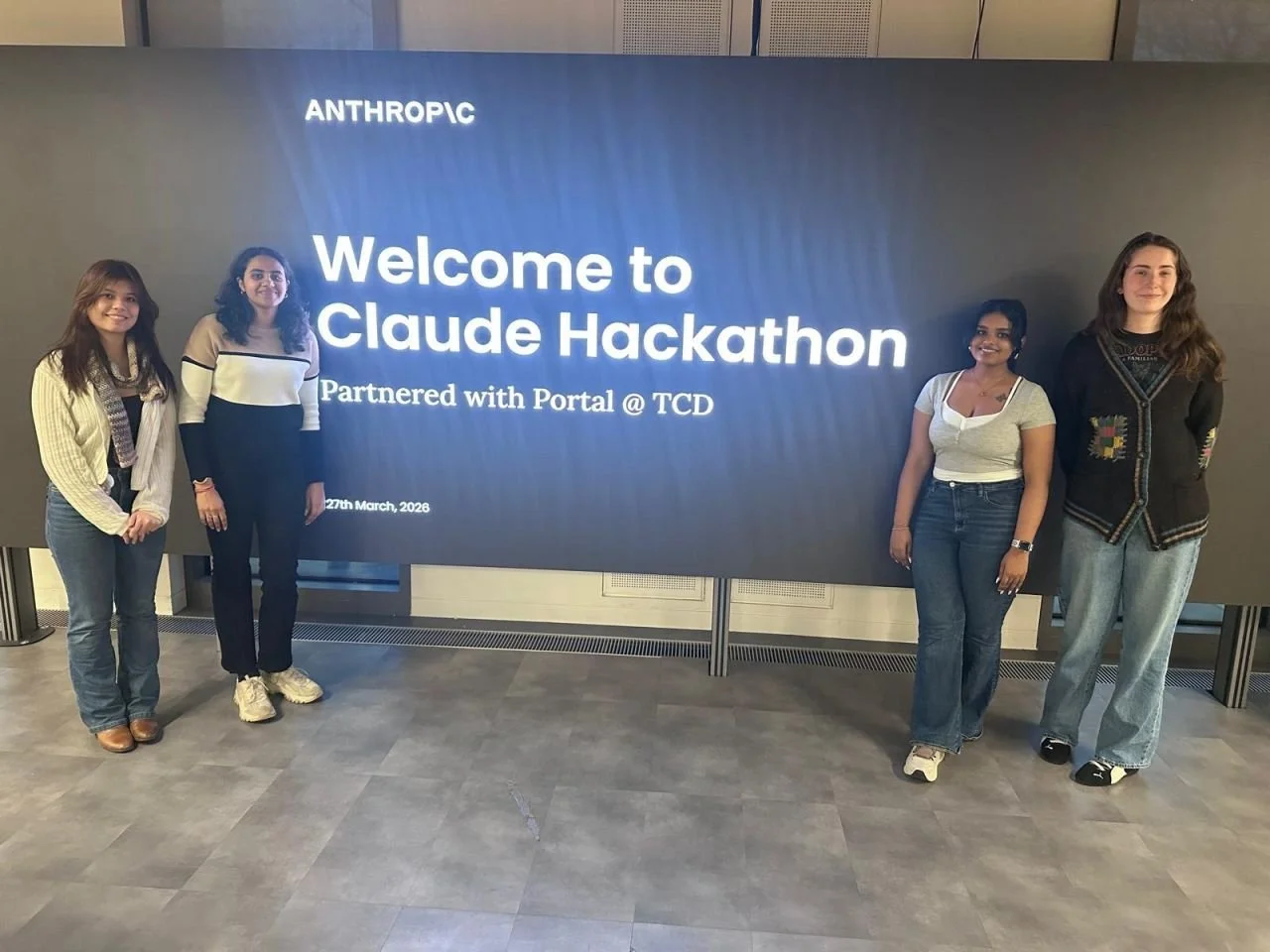
Students at Trinity College Dublin take part in the Claude AI hackathon, where teams built tools including WatchWise, a project analyzing cognitive load in children’s digital content. Photo credit: Emma Burgess via LinkedIn
Students at Trinity College Dublin have developed a range of AI-powered tools for education, healthcare, and civic use cases, following a Claude AI hackathon organized by the Claude Builder Club @ TCD and supported by Anthropic.
The event, hosted at Portal – Trinity Innovation and Enterprise, brought together students working with large language models to build functional prototypes across multiple tracks, including education, neuroscience, and public systems.
Participants shared project outcomes on LinkedIn after the event, providing insight into how AI tools are being applied in short-form, collaborative environments within higher education.
Student projects focus on education access and feedback systems
Several projects addressed education-specific challenges, particularly around access to information and student voice.
Kush Voorakkara, a Computer Science student at Trinity College Dublin, said: “Our project, Clarity, takes municipal budget data and turns it into something a normal person can actually read. Plain-language, address-specific breakdowns of where your local money goes.”
The project won the Economic Empowerment & Education track and reflects a focus on making complex systems more accessible through AI.
Another project, Voxify, explored real-time feedback systems for education institutions. Aman Bansal, MSc Business Analytics student at Trinity College Dublin, said: “Students often have opinions — but lack: A safe way to express them A fast way to be heard A system that turns feedback into action.”
He added: “Voxify aims to bridge that gap by making feedback: Anonymous Real-time Easy to participate in.”
The projects highlight how students are using AI tools to address communication gaps and accessibility challenges within education environments.
Healthcare and cognitive tools developed using AI models
Healthcare-focused applications also featured at the hackathon, including a project targeting early-stage Parkinson’s screening.
Atharva Kocharekar, a Machine Learning Engineer and student, said: “So we built a screening tool not a diagnostic one, but a first-signal one.”
He added: “At its core: an XGBoost model with strong benchmark metrics running at inference, wrapped in 3 layers of analysis.”
The system analyzes gait, finger tapping, and voice patterns, with a focus on explainability and early detection.
Another project, WatchWise, analyzed video content to assess cognitive load in children, using multiple AI agents to evaluate pacing, sensory intensity, and reward mechanisms.
Hackathons provide environment for rapid AI prototyping
Other projects extended into civic and global applications. AidAtlas, developed during the event, focuses on humanitarian response by mapping areas of need and linking them to volunteer interest and coordination.
Sinclair Philandrianos, a student at Trinity College Dublin, said: “The platform is not just about showing where the problem is. It is about creating a path from: need -> visibility -> volunteer interest -> organised action.”
Across the hackathon, participants emphasized the pace of development and the ability to move from concept to working prototype within a short timeframe.
Posts from attendees also pointed to the collaborative and practical nature of the event. Milan Varghese, a Computer Science student, described “brainstorming wild concepts to bringing them to life in a short span of time.”
The Claude Builder Club @ TCD describes itself as a student-led community focused on building and experimenting with large language models, with support from Anthropic.
The range of projects shared following the hackathon provides a snapshot of how students are using AI tools in applied contexts, with a focus on usability, accessibility, and real-world problems.